The Nature will Fjord You! Sailing the Norwegian Riviera

Updated: Aug 10
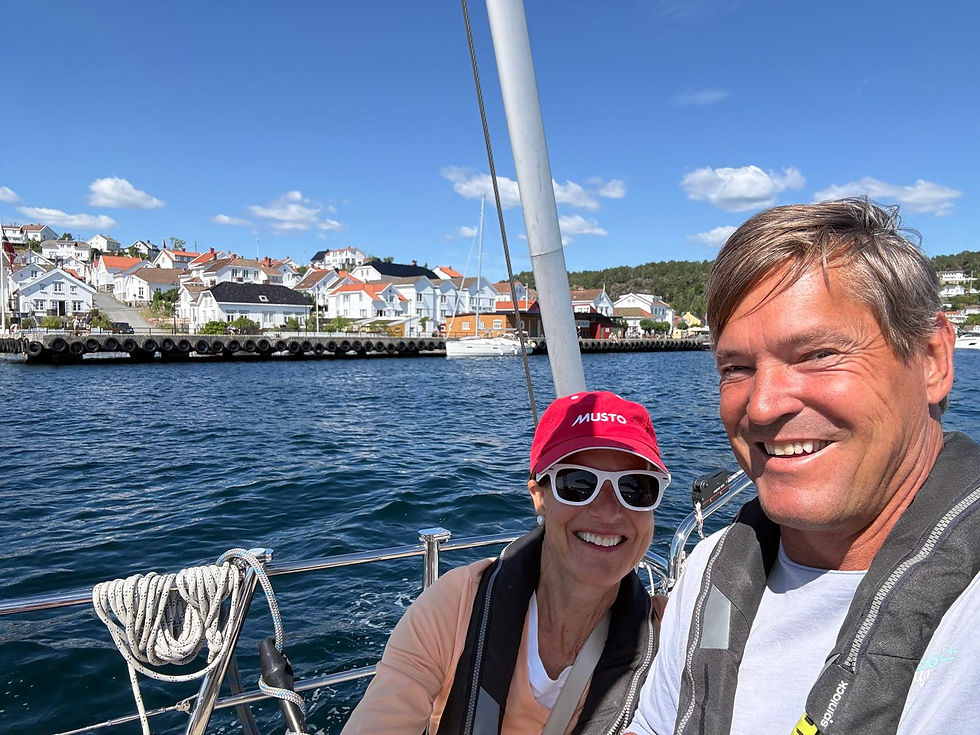
More than 10,000 years ago, all of Norway was covered by a giant glacier whose edges marched out to sea, freezing the ocean itself. When the ice retreated, it shoved boulders, gravel and sand together into a beautiful island now called Jomfruland, the largest mound of rock and earth in a vast, mostly underwater park. This “geo park” sits far out in the Kragerø archipelago, pushing into the powerful Skagerrak sea of Viking lore. “You have to see Jomfruland,” several Norwegian sailors implored. Multiple micro-ecosystems — sandy beaches, oak forests, pebbled inlets — look out over giant “kettles” (holes in the rock) under the waterline.


As a heat wave blew hot air over inland areas, it seemed the whole nation, like a Norse battalion, decamped to the water, summersaulting and diving off boats of all sizes in marinas or anchored to rocky cliff walls lining the sea. Young people zoomed around on skiffs and inflatables, as if watercraft were extensions of their bodies. Suddenly, thousands of tiny Vikings morphed into platoons of motorized sea horses and mermaids. Plunk! Splash! Zoom!
We lolled and strolled around tranquil Jomfruland, occasionally pondering our windlass problem. It was too hot to move, or think too much, so we fell into a pleasant summer daze, content to watch the wakes, kerplunks and vrooms of the motorized Viking young.
When the winds picked up, we sailed west to Risør, called “The White Wooden City,” sprinkled with cafés and Mediterranean flair. A fellow with John Lennon glasses and a scruff named “Dag” padded over to our boat, gesticulating in his worn-out Patagonia fleece. “Ahhh, Sirius! My dream boad. I’m looking for a Sirius 310!” Dag explained his years-long odyssey in search of a pre-owned version of our boat — a story we hear in many a marina. “I grew ap in dat house right dehr,” the man continued, pointing toward the delicate meringue center of the city.

”Now my wife and I spend vinters in San Remo. Except for Christmas — vee ski at our cabin here in the nort of Norway.” Looking at a map, you would think that all of Norway is “north.” But this coastline between Oslo and Kristiansand is called the “Sørlandet” (South Land) or “Norwegian Riviera” because of its high count of sunny days, warm summer climate, and enchanting towns.

A ferry to Kragerø slalomed through fjords scooped out of forest-blanketed mountains, making our jaws drop at the sheer majesty of this coastline. Wood houses balanced delicately on rocky outcroppings in the sparkling blue.

Kragerø, like Risør, became a wealthy trading post in the 1600s as acres of giant spruce were shipped to Europe — especially to the Netherlands — to build cities, ships, and dikes. In a church high up on a hill crowning the city, a softspoken Norwegian man offered us cookies and Coca-cola. “The Dutch helped build this church,” he explained. In fact, the Norwegian-Dutch timber trade generated immense wealth, fueling the Dutch Golden Age and the creation of Norway’s merchant elite. The trade was not a one-way resource extraction. As the Dutch built Amsterdam on massive Norway spruce pillars, ships ferried luxury goods, mining investment and silver currency back to the Sørlandet to pay for the timber. Riches flowed.
While we soaked up the resulting exquisite architecture and stylish boutiques in Kragerø’s old town, stopping for a delicious iced latte and carrot cake at the busy Stavelin café, we had less success finding a boat mechanic to address our anchor problem. The thing about boat problems, like car problems, is they don’t go away by themselves. “Not this week. Next week — maybe,” said the main marina firm in Risør. “Sorry, I can’t help you for at least three weeks,” said Jan Martin, an expert recommended by Dag, the Risør native.
Gero rigged up a bag of heavy rocks to our spare “fluke” anchor (remember “The World’s Best Anchor”?) in hopes that we could enjoy another quiet experience in the fjords before docking into our next marina. Near the island of Buøya, we purred into a promising shallow bay. As a group of teenagers used their cabin cruiser as a diving board, blasting American rock songs nearby, we set anchor a few times manually.

My beautiful, strong husband lowered the anchor by hand as I stood at the helm, dipping the throttle into reverse. The first three times, the anchor and our 30 kg rock bag failed to grip the seabed as the boys nearby belted out “Baby, we were born to run!” Were they singing about our dragging anchor? Gero cut off the rocks and we tried again. The wind picked up.

The anchor held! We broke out of our backgammon set and celebrated with ginger vodka mules. Cocktails taste better when you know your boat isn’t going to drag into a rock island any minute! The joyful boys packed up around dinner time, scampering up the steep hills surrounding us, as the bay fell into silence and the wind died. Thankfully, the anchor held all night.
The next morning, Gero hauled in the anchor and we set our course for Arendal, sometimes called the Venice of Scandinavia. Could this famous city of canals possibly channel us to an available boat mechanic?


Comments